A 3,000 lb kraft roll that wanders out of round in storage, a corrugator operator with a wrist strain off the back of a single shift, an unscheduled stoppage because a wet end roll could not be repositioned: these are the daily costs of moving paper rolls the wrong way. Manual handling has consistently accounted for 17% of all non fatal workplace injuries in Great Britain (HSE Health and Safety at Work: Summary Statistics 2024/25), and back injuries make up 43% of all work related musculoskeletal disorder cases, the single largest category. In a paper mill, converter or corrugator, the loads are heavier, the surfaces are less forgiving, and the consequences of a damaged roll can run to thousands of pounds in scrap.
This guide explains how to move heavy paper rolls safely, what equipment to specify, and how to reduce both injury risk and product damage at the same time.
Why moving paper rolls is uniquely difficult
Paper rolls combine four awkward characteristics that most material handling equipment was never designed for:
- Weight. A finished kraft, newsprint or coated paper roll can range from 800 kg to over 5,000 kg.
- Geometry. Rolls roll. They are cylindrical, with a fragile outer wrap and a hollow core that does not tolerate point loads.
- Surface sensitivity. Softer grades such as newsprint, supercalendered paper and machine finished speciality paper deform easily under clamp pressure or uneven contact, leading to out of round defects that cause web breaks at press.
- Floor variability. Mills typically have painted concrete, expansion joints, drains, slight cambers and the occasional broken edge of a roll stand track. All of these increase rolling resistance and make manual pushing genuinely dangerous.
The result is that operators end up applying high, sustained, repetitive forces, often in awkward postures. In a published OSHA Ergonomics Success Story at an AF&PA member containerboard packaging facility (NAICS 32221, 140 employees), workers were manually pushing rolls of approximately 3,000 lb across uneven concrete and over roll stand tracks at the corrugator, exposing wrists, shoulders, backs and knees to the kinds of forceful exertion that drive cumulative trauma claims. The site solved the problem by deploying battery powered roll pushers at each corrugator single facer.
The three categories of paper roll handling equipment
Before specifying a solution, it helps to understand the families of equipment available.
1. Clamp truck (forklift with paper roll clamp)
Useful for moving palletised paper or bulk rolls over longer distances, but clamp pressure must be carefully managed to prevent core damage, telescoping, or out of round defects.
2. Overhead crane or jib crane with core probe
Effective for lifting and positioning, but fixed in location, slow, and unsuited to congested production floors.
3. Pedestrian roll pusher (powered or pneumatic)
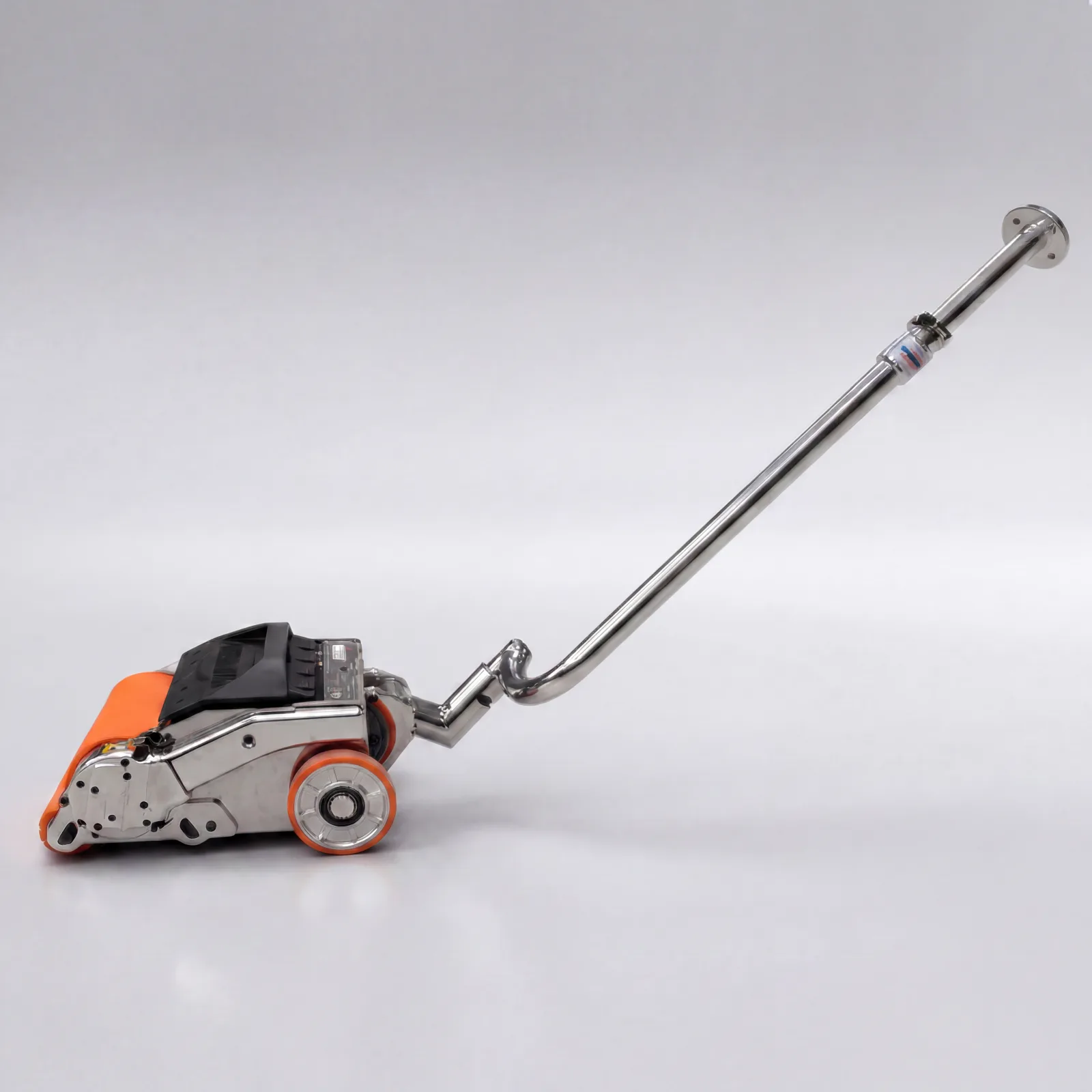
A walk behind machine that grips the back of the roll and uses its drive wheel to push, pull and manoeuvre the roll at floor level, with a single operator at the controls.
For most day to day movement inside a paper or pulp facility, the pedestrian roll pusher is the right answer. It keeps the roll on the floor, eliminates lifting, requires no operator licence, and frees the forklift fleet for longer haul, palletised tasks.
How a battery powered roll pusher works
A pedestrian roll pusher uses a powered drive roller that contacts the side of the paper roll. As the operator engages the variable throttle, the drive roller rotates the paper roll about its own axis, moving it precisely across the floor. The geometry means very little force reaches the operator, and the operator never has to lift.
Modern designs use one of two power sources:
- Battery powered units with drop in NiMH or lithium ion battery packs that exceed an eight hour production shift on a single charge.
- Pneumatic units that run from a standard 7 to 8 bar (101 to 116 PSI) compressed air supply with no battery, ideal for continuous duty applications where compressed air is already plumbed throughout the plant.
Powerhandling's PowerRoll range covers both: the battery powered PowerRoll L Series (up to 80,000 lb, around 36,287 kg), G Series (up to 75,000 lb, around 34,019 kg), and V Series (up to 10,000 lb, around 4,536 kg), alongside the pneumatic PowerRoll A Series (up to 62,000 lb, around 28,123 kg) and T Series (up to 22,400 lb, around 10,160 kg). The patented Direct Drive design houses the motor and gearbox inside the drive roller, which improves reliability, reduces machine size and eliminates drive related maintenance.
Matching the machine to the roll
Specifying the right machine starts with five questions:
- What is the heaviest roll you need to move? Quote the loaded, finished weight, not the core weight.
- What grade of paper are you handling? Soft grades such as newsprint, tissue and SC paper need a large, gentle drive roll surface to avoid impression marks. Powerhandling's PowerRoll T Series uses a large drive roll specifically engineered for non woven fibre and tissue paper, and the company states the T Series reduces material waste for tissue paper manufacturers.
- Is compressed air already available? If yes, pneumatic units (A and T Series) deliver continuous duty with no battery management.
- Is the floor smooth, painted concrete, or rough mill floor with tracks and drains? Rougher floors increase rolling resistance and need more torque at the drive wheel.
- How far do you need to move the roll? Short positioning moves favour compact battery units; longer reposition tasks favour pneumatic or larger battery models.
Reducing MSDs and protecting your insurance position
Switching from manual roll moving to a powered roll pusher delivers three measurable benefits:
- Injury prevention. Pushing forces are absorbed by the machine rather than the operator's lower back. HSE's Costs to Great Britain of Workplace Injuries and New Cases of Work Related Ill Health (2023/24) puts the total cost at £22.9 billion, of which ill health (including MSDs affecting 511,000 workers) accounts for £16.4 billion, with £4.3 billion falling directly on employers. The payback period on a single roll pusher in a busy corrugator can be measured in months.
- Roll quality. Controlled drive pressure prevents the deformation and out of round defects that drive web breaks, splice issues and press downtime.
- Productivity. A single operator with a powered pusher can do work that previously required two or three people with a manual cart, freeing labour for higher value tasks.
Industry applications
Powered roll handling equipment is used across:
- Kraft and corrugating plants moving roll stock between storage, splicers and the corrugator.
- Tissue mills where soft grades demand gentle, large diameter drive rolls.
- Newsprint and publication printers where out of round defects directly affect web stability.
- Coated, film and foil converters moving high value rolls between processes.
- Pharmaceutical label converters moving smaller, high value paper label rolls.
FAQ
What is the safest way to move a heavy paper roll?
The safest method is a pedestrian operated, powered roll pusher that keeps the roll on the floor, contacts only the engineered drive surface, and requires no manual lifting or pushing force from the operator.
Do you need a licence to operate a powered roll pusher?
No. Unlike forklifts and overhead cranes, pedestrian operated roll pushers do not fall under Lifting Operations and Lifting Equipment Regulations (LOLER) in the UK, because they do not lift loads. Brief task specific training is sufficient.
How heavy a roll can a single operator move?
With a correctly specified machine, a single pedestrian operator can move paper rolls of up to 36,287 kg (80,000 lb) safely using a unit such as the Powerhandling PowerRoll L Series.
Can roll pushers handle soft tissue and newsprint without damage?
Yes, provided the drive roll is sized and engineered for soft grades. Large diameter, urethane bonded drive rolls distribute contact pressure and prevent impression or tearing.
Specify the right paper roll handling solution with Powerhandling
Powerhandling has spent more than 20 years engineering compact, powerful, single operator roll pushers used in paper mills, converters and corrugators across 86 countries. Our PowerRoll L, G, V, A and T Series cover the complete weight and material range, and every unit is available on a no obligation demonstration programme so you can trial it in your own facility before you commit.
Speak to our team today for a free application review, or book a demonstration at your facility through the contact form on powerhandling.com. You may also be interested in our Paper Chocks and Mobile Paper Turner accessories.
See Our Equipment in Action
Book a demo at your facility and see our equipment in action.
Request Your Demo
Tell us what you're moving and how heavy it is. We'll arrange a demo of the right machine at your facility.
Request Your Demo